
Last updated October 16, 2026
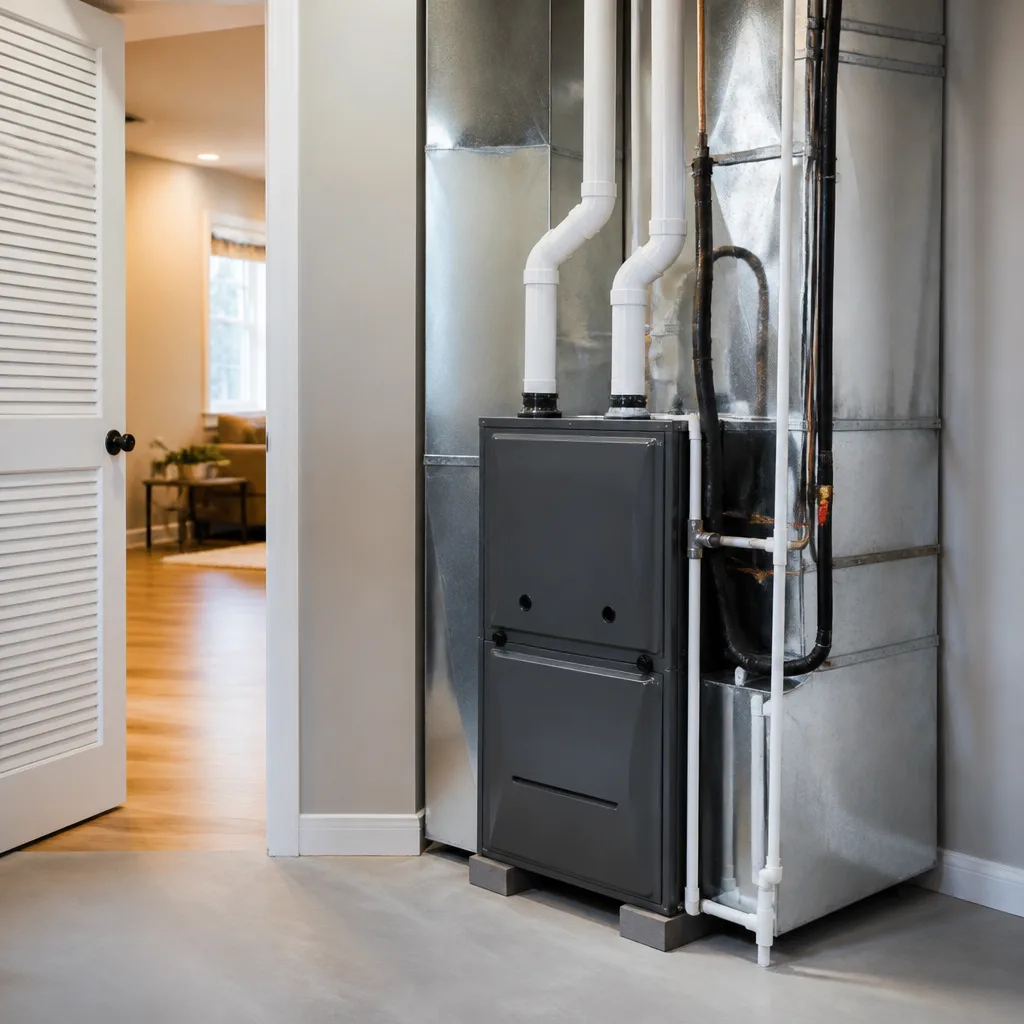 Furnace & heating
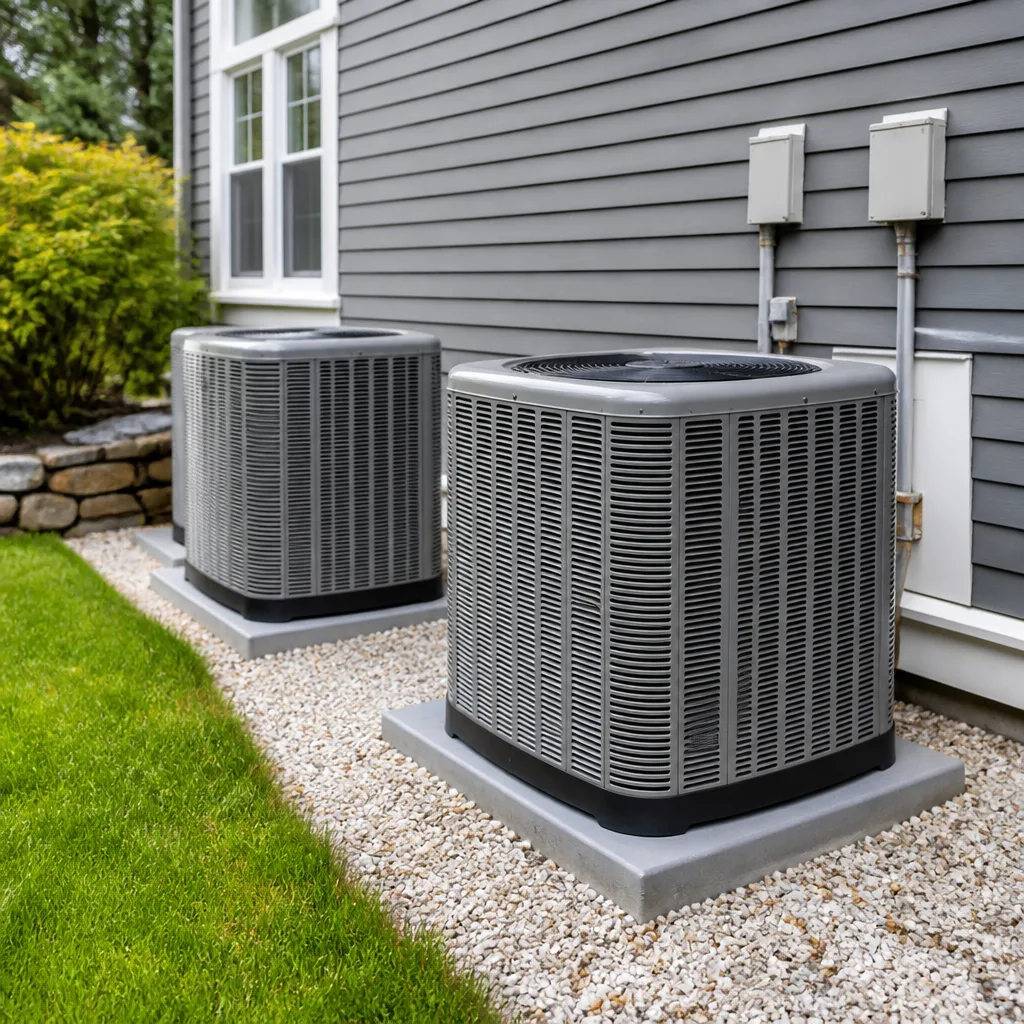 Heat pumps
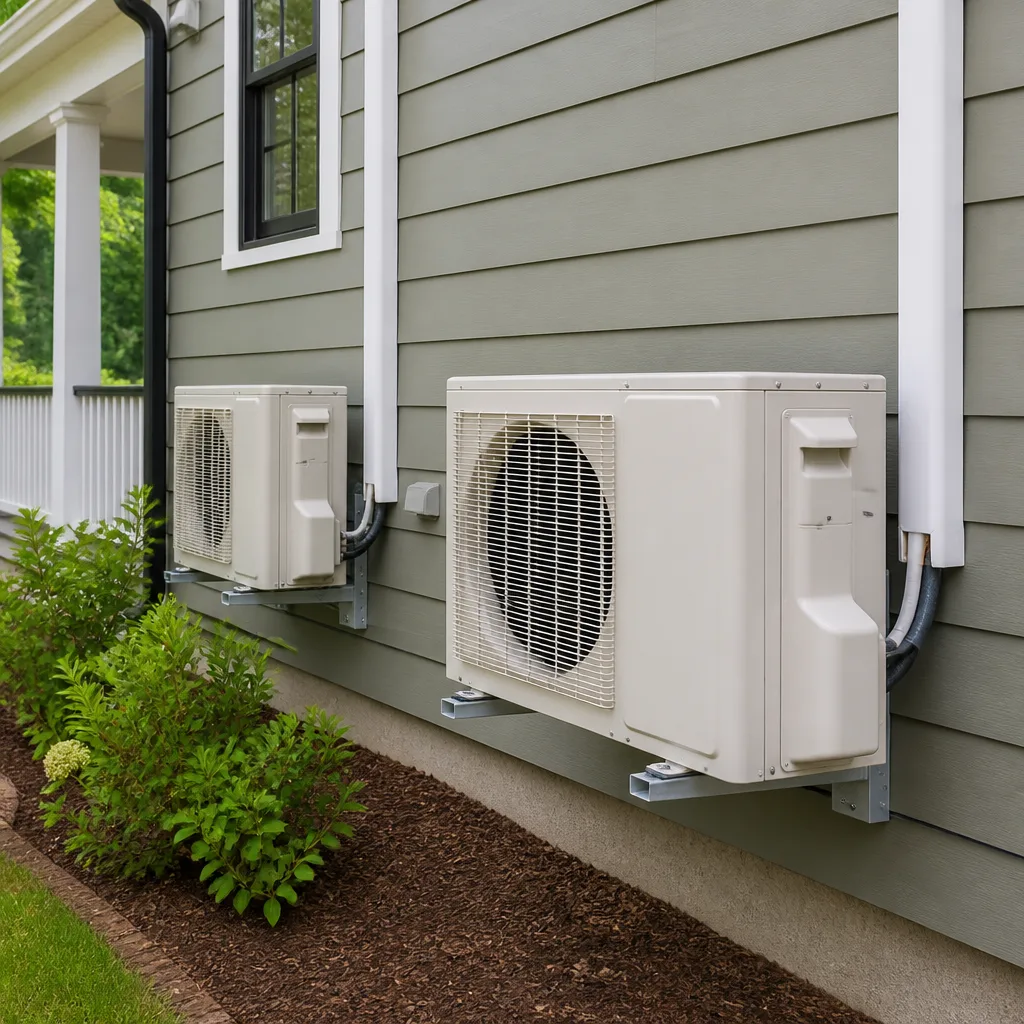 Ductless mini splits
 Carrier
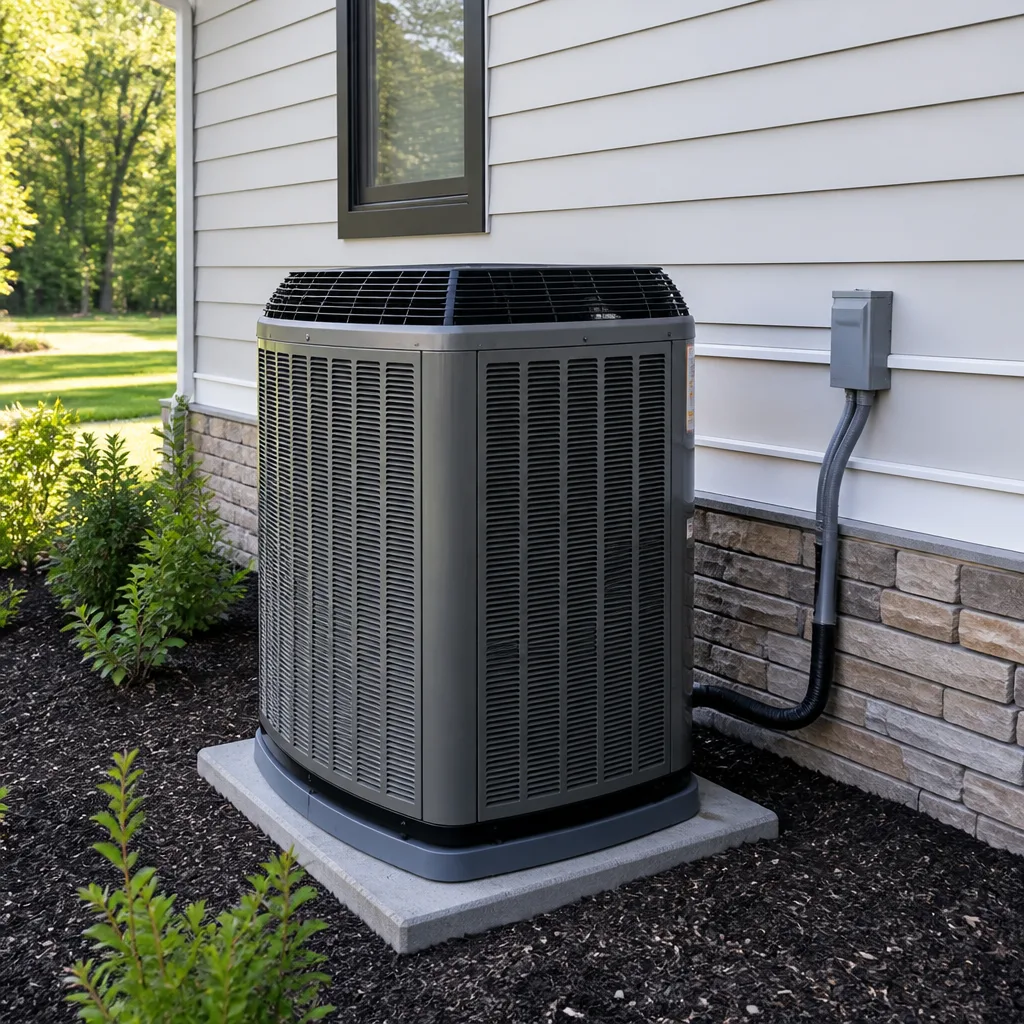 Trane
Trane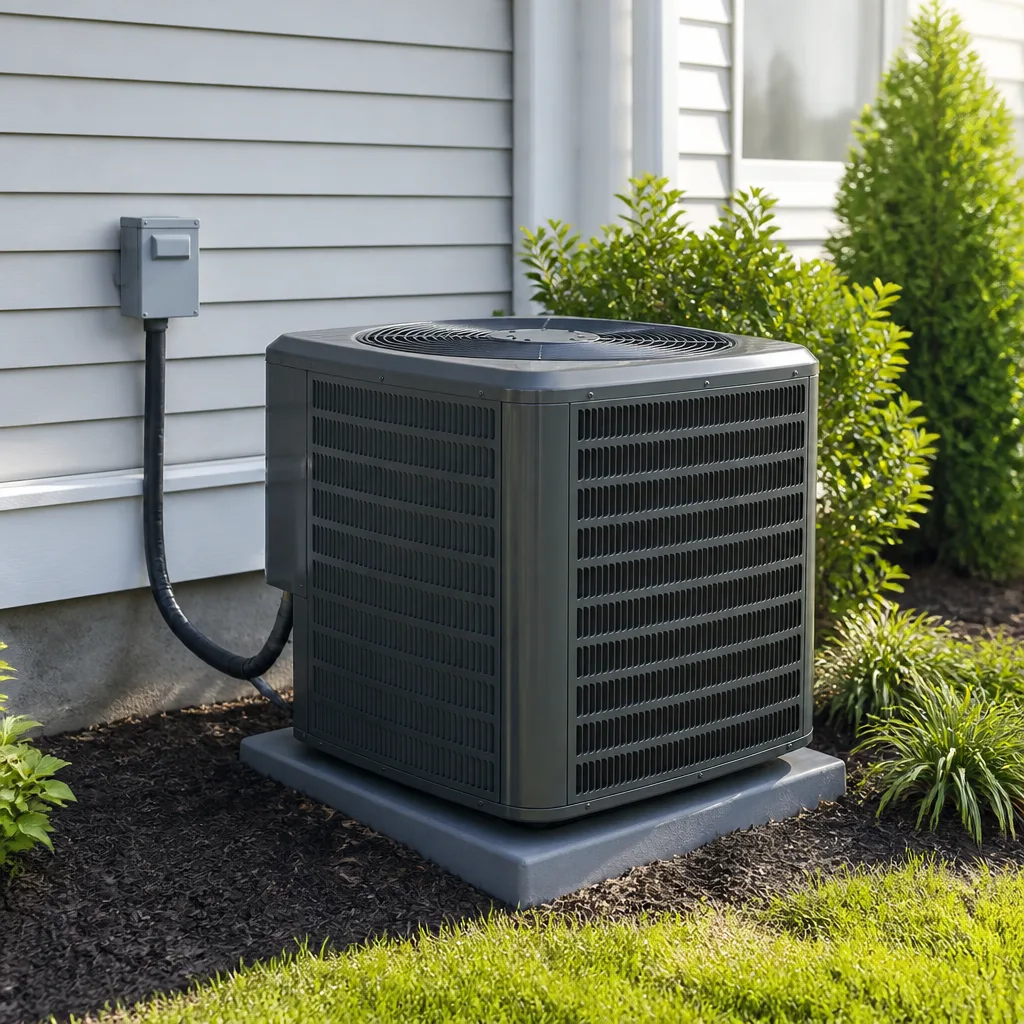 Goodman
Seasonal tune-up and full diagnostic on your Carrier, Trane, or Goodman system - readings shown to you before any repair is proposed
Diagnosis first, numbers second - you approve the repair price before a single part goes in.
Get your free estimateHVAC Cost Breakdown: The San Antonio Homeowner’s Reference for 2026
The same 3-ton AC replacement in San Antonio can be quoted anywhere from $6,800 to $13,500 by licensed contractors, and both quotes can be legitimate. The difference is rarely markup greed. It comes down to equipment tier, warranty length, what the installation actually includes, and whether the contractor pulled a permit. Most cost guides you find online run national averages that ignore San Antonio’s specific market: its brutal summer load, its older housing stock, its CPS Energy rebate structure, and the hard reality that our cooling season runs nine months a year. This guide replaces guesswork with real 2026 price ranges, explains what drives the spread, and arms you with the questions that force every contractor to quote the same scope of work. For more guides & resources, see our full library.
Quick Answer
In 2026, San Antonio homeowners can expect to pay $150 – $340 for a capacitor replacement, $180 – $420 for a refrigerant recharge, $450 – $950 for a blower motor replacement, and $6,800 – $13,500 for a full AC system replacement, depending on tonnage and equipment tier. Most repairs fall between $150 and $650 when caught early, and most full replacements land between $8,500 and $11,500 after CPS Energy rebates and federal tax credits are applied. Seasonal demand between May and September pushes repair and install pricing up 15 – 30%, so scheduling work in the shoulder season is the single biggest lever for saving money without cutting quality corners.
Styles & brands we work with
Table of Contents
- The 10 Most Common San Antonio HVAC Jobs: 2026 Price Ranges
- Labor-Only vs. Parts-and-Labor Quotes: What Those Terms Actually Mean
- Why Two Quotes for the Same Job Can Differ by Thousands
- CPS Energy Rebates and Federal 25C Credits: Real Dollar Examples for 2026
- Why San Antonio Pricing Spikes 15 – 30% Between May and September
- The Three Questions That Force a Comparable Quote
- Repair or Replace? A San Antonio-Specific Framework
- Common Mistakes to Avoid
The 10 Most Common San Antonio HVAC Jobs: 2026 Price Ranges
Here are the repairs we see most often across San Antonio, from Alamo Heights to Stone Oak to the West Side. These ranges reflect what a licensed contractor in our market actually charges in 2026, parts and labor included. They are not national averages. They reflect the labor market in Bexar County, the equipment brands most common in our housing stock, and the reality that San Antonio AC systems work harder than systems almost anywhere else in the country.
- Capacitor replacement: $150 – $340. A capacitor is a small cylinder that gives the compressor and fan motor a jolt of electricity to start. When it fails, the AC hums but does not cool.
- Condensate drain line clearing: $120 – $275. San Antonio humidity means algae and sediment build fast. A clogged drain can trigger a safety float switch that shuts the system down entirely.
- Blower motor replacement: $450 – $950. The blower pushes cooled air through the ducts. Motor cost varies by whether it is a single-speed, multi-speed, or variable-speed unit.
- Refrigerant recharge (with leak check): $180 – $420 for R-410A systems, $350 – $700 if the system uses older R-22, which is no longer manufactured and keeps climbing in price. A recharge means refilling the fluid that moves heat out of your home. It should always include a leak check, because refrigerant does not get used up. If it is low, it escaped somewhere.
- Evaporator coil replacement: $1,200 – $2,800. The evaporator coil sits inside and absorbs heat. In San Antonio’s high-runtime climate, coils corrode faster than in northern markets, especially in homes with poor attic ventilation.
- Condenser fan motor replacement: $300 – $600. The outdoor fan rejects heat. Cheap aftermarket motors fail faster in our heat; OEM motors cost more but hold up.
- Thermostat replacement or upgrade: $140 – $400 installed. A smart thermostat can cut runtime during the 14 hours a day your AC runs in August, but installation should be done correctly to avoid short-cycling.
- Compressor replacement (under warranty): $900 – $1,600 labor plus diagnostic. The compressor is the pump that circulates refrigerant. If it fails outside warranty, replacement often costs 60 – 70% of a new system, which makes replacement the smarter call.
- Duct sealing (partial): $800 – $2,200 depending on how much of the ductwork is accessible. San Antonio homes built before 2000 routinely lose 20 – 30% of cooled air to duct leaks in attics that reach 140°F in July.
- Full AC replacement (including furnace where applicable): $6,800 – $13,500 all-in, including equipment, installation, disconnect, pad, plenum, drains, thermostat, start-up, and haul-away. By tonnage: 2-ton ($6,800 – $9,500), 3-ton ($7,500 – $11,500), 4-ton ($8,800 – $12,500), 5-ton ($9,500 – $13,500). These figures assume a standard efficiency unit. Higher-SEER variable-speed systems run 20 – 40% more.
One thing worth naming plainly: the cheapest quote in each range almost always excludes something. A $6,800 3-ton system might mean a bare-bones 14-SEER unit with no new thermostat, no permit, and no communication about the warranty registration. A $9,500 quote might include a variable-speed air handler, a 10-year parts-and-labor warranty, and full CPS Energy rebate filing. Neither quote is dishonest. They are just quoting different jobs.
Labor-Only vs. Parts-and-Labor Quotes: What Those Terms Actually Mean
When you get a quote, one of the clearest signals of how a contractor prices is whether they separate labor from parts. Some do, some do not. Neither model is inherently better, but you need to understand what you are looking at to compare two quotes honestly.
Labor-only quotes are most common on large equipment jobs. The contractor gives you a fixed price for removal and installation labor, then adds the equipment price separately. The advantage is transparency: you can see exactly what you are paying for the work versus the machine. The disadvantage is that equipment prices can shift between quote and install, and some contractors use labor-only pricing to look cheaper on paper, then add line items later: crane rental, electrical disconnect, permit fees, drain pan replacement.
Parts-and-labor quotes bundle everything into one number. These are standard in San Antonio residential work, especially for repairs. A parts-and-labor quote for a blower motor at $650 means the motor, the service call, the diagnostic time, the installation, and the return visit (if the part fails within the warranty window) are all included. There should be no surprise line items at checkout.
Here is what to watch for. On a full system replacement, certain line items are fixed costs you cannot negotiate away: refrigerant, electrical disconnect, permitting, and code-required safety items like a plenum or pad elevation. Other items have some flex: thermostat choice, media cabinet upgrades, duct transition work, extended labor warranties. The negotiable items are where honest contractors will work with you. The fixed items are where some less scrupulous ones pad their margins.
In our experience, the cleanest comparison is a parts-and-labor quote that lists the major components by name and model number. If you get a quote that says “3-ton AC, installed, $7,200” with no model number, no SEER rating, and no mention of a permit, you do not have a quote. You have a number. Numbers are easy to walk away from; quotes are what you compare.
Why Two Quotes for the Same Job Can Differ by Thousands
San Antonio homeowners routinely get three quotes for a full system replacement and find a $5,000 spread between the lowest and highest. Before you assume the high bid is gouging, understand the legitimate variables. Each one changes the job scope, which changes the price, which means the two quotes are not actually for the same job.
Equipment tier. A Bryant, American Standard, Carrier, or Trane base-model 14-SEER single-stage unit costs less than a 17-SEER two-stage unit, which costs less than a 20-SEER variable-speed unit. The difference in equipment cost alone can be $3,000 – $5,000. Higher tiers are quieter, better at humidity control, and cheaper to run, but the upfront premium is real.
Warranty term. The standard manufacturer warranty covers parts for 10 years if registered. Labor is typically covered for 1 year by the installing contractor. If a quote includes a 10-year labor warranty, that coverage costs money, and it shows up in the price. In our market, where a compressor can fail in August, labor warranty is worth more than in milder climates.
Installation quality. This is the invisible variable. Does the contractor pull a permit and schedule a city inspection? Does the install include a new disconnect box, a properly sealed plenum, a new pad, and a refrigerant line set flush with nitrogen? Or is the crew reusing old duct connections and skipping code details? A proper install takes a two-person crew a full day. A rushed install takes half that. You pay for the difference, and you feel it in the July electric bill.
Company overhead. A contractor who runs background-checked technicians, maintains a stocked parts van, answers phones at midnight in August, and carries commercial liability insurance has higher overhead than a two-man operation working out of a pickup. That overhead is the price of accountability. When a system fails at 10 p.m. on a Sunday in July, the company with overhead is the one that answers.
CPS Energy Rebates and Federal 25C Credits: Real Dollar Examples for 2026
Here is where San Antonio homeowners leave real money on the table. CPS Energy offers rebates on qualifying high-efficiency equipment, and the federal 25C tax credit is still active in 2026. Combined, they can cut the out-of-pocket cost of a new system by $1,500 – $3,500 depending on the equipment tier.
CPS Energy rebates in 2026 are structured around SEER2 efficiency ratings. A qualifying 16-SEER2 air conditioner typically carries a rebate in the $300 – $600 range. Heat pump conversions, which CPS Energy has pushed hard in recent years, often qualify for higher incentives, sometimes exceeding $800. The rebate is applied at purchase when you work with a contractor registered in the CPS Energy program, not mailed to you months later. Always confirm the contractor is registered before you sign.
The federal 25C credit covers 30% of the equipment cost for qualifying heat pumps and central AC units that meet efficiency thresholds, up to a $2,000 annual cap. On a $9,000 qualifying heat pump installation, that is a $2,000 direct reduction in your tax liability for the year. The credit is non-refundable, meaning it can reduce your tax bill to zero but will not generate a refund, and it carries income-eligibility requirements. Consult a tax professional, but do not skip it.
Let us put real numbers to it. A San Antonio homeowner replacing a 3-ton AC with a qualifying 16-SEER2 unit in 2026:
- Equipment and installation: $9,200
- CPS Energy rebate: – $500 (applied at purchase)
- Federal 25C credit: – $1,800 (applied at tax filing)
- Final out-of-pocket: $6,900
That is a 25% reduction. The paperwork takes an hour, and a reputable contractor files most of it for you. The key is confirming eligibility for both programs before the install date, not after. Equipment that misses the efficiency threshold by a point earns nothing.
Our AC Repair in San Antonio work regularly involves systems that are still repairable but close to end of life. In those situations, we walk through the rebate math with the homeowner so the repair versus replace decision is grounded in real dollars, not sales pressure.
Why San Antonio Pricing Spikes 15 – 30% Between May and September
Every HVAC market has a busy season. San Antonio’s is longer and sharper than most. When daytime highs cross 95°F and stay there from May through September, AC systems run 14 – 18 hours a day. Compressors fail. Capacitors blow. Refrigerant leaks that were mild in March become full failures in August. Learn to spot trouble early with our HVAC Warning Signs: A San Antonio Homeowner’s Reference Guide. Demand for service spikes, and pricing follows demand.
Labor is the first thing that gets expensive. Contractors in Bexar County run crews seven days a week in peak season, often paying overtime to keep up with calls. Those costs get passed through as higher service-call fees and higher repair labor rates. It is simple economics, not profiteering. A contractor who charges $89 for a capacitor replacement in February might charge $220 for the same repair in July, because the tech doing the work is on his eleventh call of the day and the company is paying him time-and-a-half.
Equipment prices also move, though less dramatically. Distributors in Texas hold summer pricing from roughly April through October. The same 3-ton Bryant unit that costs the contractor $3,100 in January costs $3,500 in June, because that is when every contractor in the region is ordering. The increase flows to the consumer.
Here is the practical play. If your system is over 12 years old, do not wait for it to die in August. Have it evaluated in October, November, or February, when demand drops and contractors compete for your business. For a complete maintenance calendar, see Seasonal HVAC Care for San Antonio: Year-Round Homeowner’s Guide. The same full-system replacement that costs $11,000 in July often costs $8,500 – $9,500 in late fall, and you get the crew’s full attention instead of the tail end of a 12-hour day. The equipment is identical. The workmanship is often better, because the crew is not rushing to the next no-AC call.
Scheduling maintenance in the off-window is the single highest-ROI decision a San Antonio homeowner can make. A AC Maintenance in San Antonio visit in February or October catches small issues before the heat turns them into expensive failures, and the pricing reflects the season.
The Three Questions That Force a Comparable Quote
Most homeowners compare quotes the wrong way. They look at the bottom-line number and assume the lowest bid is the best deal. The problem is that two quotes for the same equipment can differ by $3,000 because one includes a permit, a 10-year labor warranty, and a registered equipment serial number, and the other includes none of those. You are not comparing two prices. You are comparing two different jobs.
Here are the three questions to ask every contractor, in writing, before you compare their numbers.
- “Is the permit included in this price, and will you schedule the city inspection?” In San Antonio, residential HVAC replacements require a city permit. It costs $150 – $400 depending on job scope. Some contractors quietly omit it from the quote, then the homeowner gets a notice from the city. A contractor who refuses to pull a permit is telling you how they feel about oversight. Walk away.
- “Exactly what does the warranty cover, for how long, and is labor included?” Standard is 10 years parts (if the equipment is registered) and 1 year labor from the installer. If a quote does not specify labor coverage, assume it is 1 year. Some contractors offer 5- or 10-year labor warranties at an additional cost. Get the labor warranty in writing before you sign, not as a verbal promise.
- “Send me the model numbers and SEER2 ratings for the equipment in this quote.” A real quote names the equipment. If a contractor cannot tell you the model number of the unit they are proposing, they are either disorganized or hiding something. Both are disqualifying. The SEER2 rating tells you what efficiency tier you are buying, and it determines your CPS Energy rebate eligibility.
One additional note for San Antonio specifically: ask whether the quote includes a new outdoor disconnect box and whether the refrigerant line set will be flushed or replaced. Older homes in neighborhoods like Jefferson, Beacon Hill, and Highland Park often have corroded disconnects and line sets that should not carry a new R-410A charge. A contractor who includes those items is doing the job correctly. One who does not is saving $300 – $500 and creating a leak risk.
Repair or Replace? A San Antonio-Specific Framework
This is the question every homeowner faces eventually. In a cool climate, a 15-year-old system might be worth nursing along. In San Antonio, where your AC runs 3,000+ hours a year, the math shifts. Here is the framework we use with homeowners.
The $5,000 rule, adjusted for our market. Multiply the repair cost by the age of the system. If the result exceeds $5,000, replacement is usually the better long-term play. A $400 blower motor on a 10-year-old system? That is $4,000. Repair it. A $1,800 evaporator coil on a 12-year-old unit? That is $21,600. Replace it. In San Antonio, you can add a climate factor: systems here age in dog years because of the runtime. A 12-year-old San Antonio AC has run about as many hours as a 20-year-old system in Minneapolis.
The refrigerant consideration. R-22 is gone. It is no longer manufactured, and what remains in the supply chain costs $150 – $250 per pound when you can find it. If your system uses R-22 and develops a leak, the recharge alone can run $500 – $900, and the leak will recur. Putting R-22 into a leaking system is paying to delay the inevitable. That money is better spent toward a new system, ideally before next summer.
The efficiency gap. A 12-year-old system might be running at 10 – 12 SEER. A modern 16-SEER2 unit uses 30 – 40% less electricity for the same cooling. On a San Antonio summer bill of $300 – $450 per month, that is $90 – $180 saved per month during peak season. Over five years, the efficiency savings alone can cover a meaningful chunk of the replacement cost, before you factor in CPS Energy rebates and the 25C credit.
If you are on the fence, get a Furnace Repair in San Antonio assessment for the heating side too. Many San Antonio homes run a combined AC-and-furnace air handler, and replacing both at once is cheaper than doing them separately.
Common Mistakes to Avoid
- Waiting until the system dies to start researching. When your AC fails in August, you are not comparison shopping. You are calling whoever answers the phone. The homeowners who get the best pricing did their homework in October. Even a rough idea of what a fair replacement cost looks like gives you leverage in an emergency.
- Comparing quotes by bottom-line number only. A $7,800 quote that excludes the permit, reuses the old line set, and carries a 1-year labor warranty is not cheaper than a $9,200 quote that includes all of those. You are comparing a complete job to a partial one.
- Skipping CPS Energy rebate registration. Every year, homeowners replace qualifying equipment and never file for the rebate because the contractor did not mention it. Confirm eligibility before install and get the paperwork from the contractor on install day.
- Buying the biggest system available. Bigger is not better in HVAC. An oversized unit cools the house fast, then shuts off before removing humidity. The result is a cold, clammy house and a system that short-cycles itself into early failure. Correct sizing matters more in San Antonio’s humid shoulder seasons than anywhere.
- Ignoring the labor warranty. The equipment warranty covers parts. The contractor covers labor, usually for 1 year. If a $900 compressor fails under parts warranty but outside labor warranty, you pay $1,200 in labor to replace it. A 5- or 10-year labor warranty costs extra upfront and is worth it in our market.
- Not asking for the technician’s name and photo before the visit. This is a homeowner-security issue as much as a pricing one. You should always know who is coming to your door before they arrive. If a company cannot tell you, that is a red flag for how they run their business.
- Paying for an emergency repair without asking the service-call fee. Some San Antonio contractors charge $150 – $250 for a peak-season diagnostic visit before any repair begins. Ask for the number when you book the call, not when the tech is standing in your living room.
See the difference
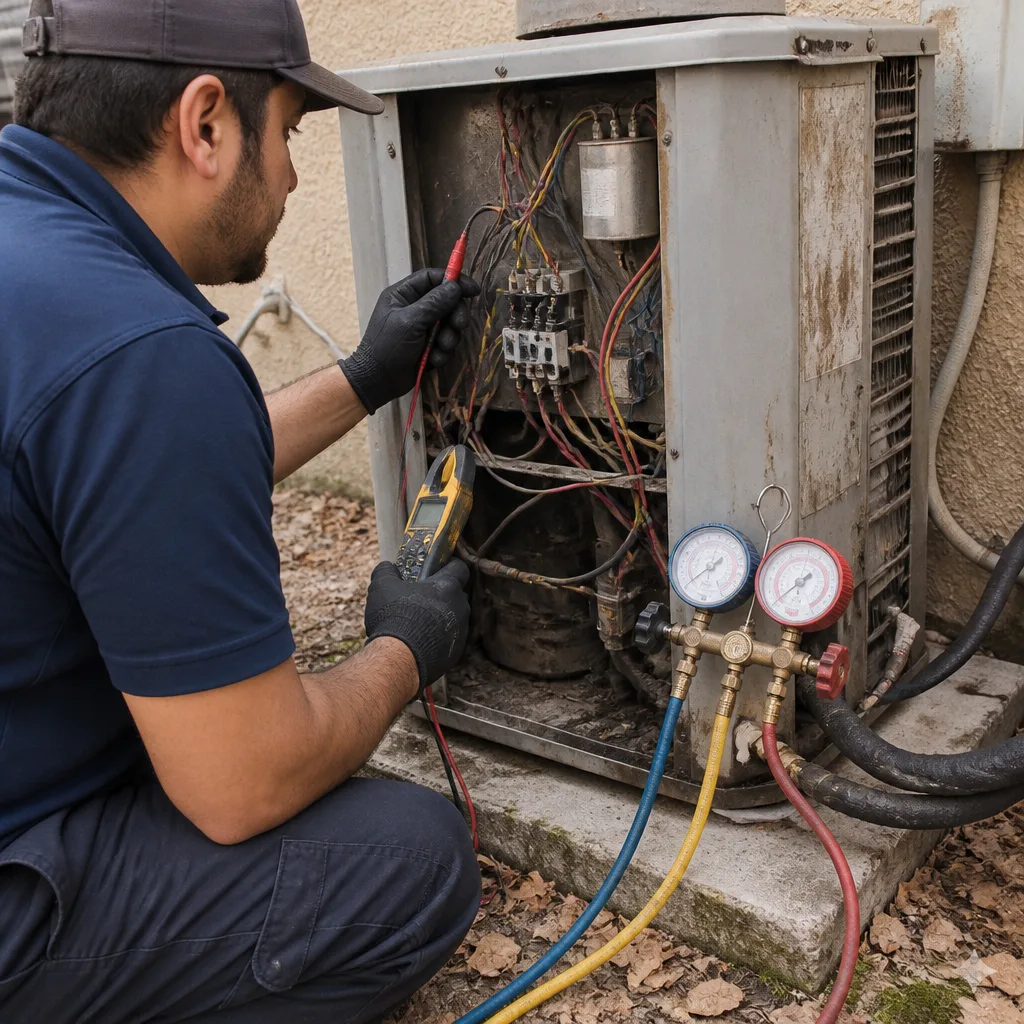 Before
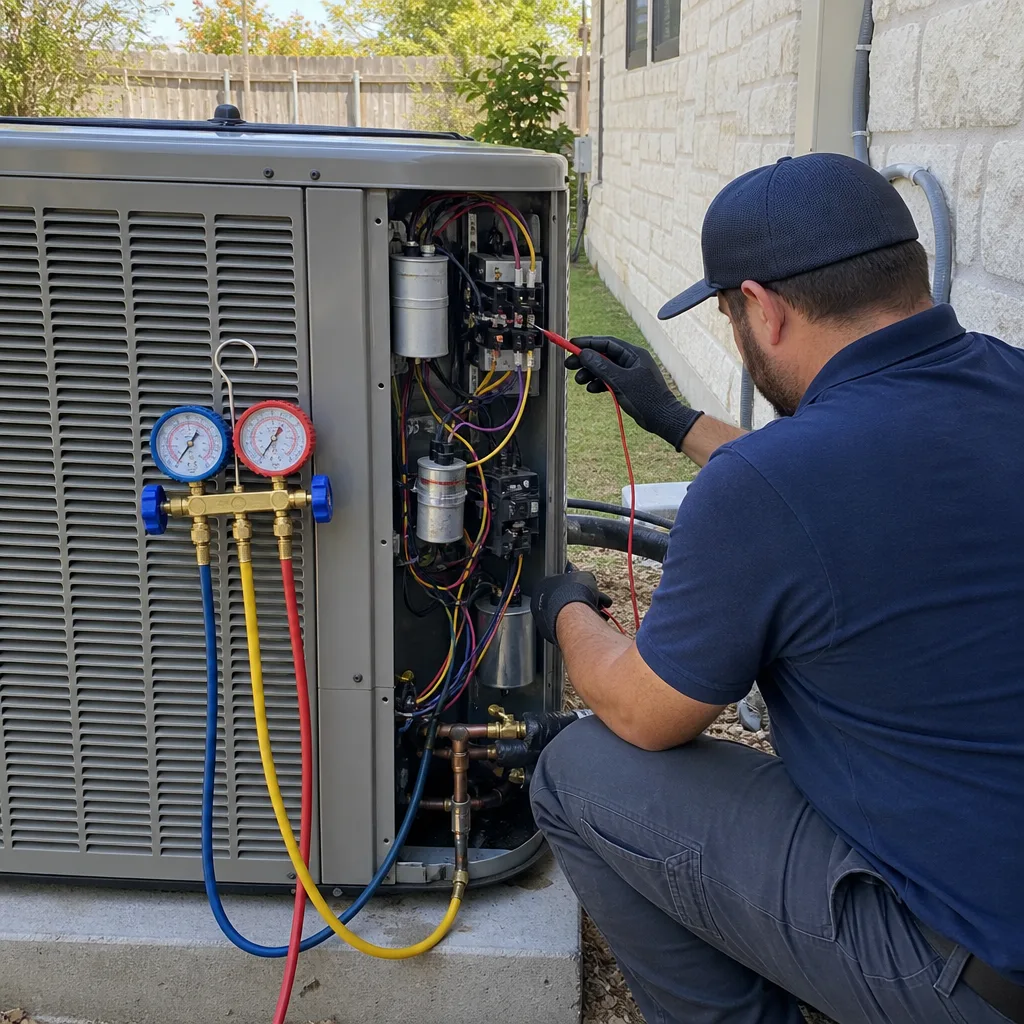 After
After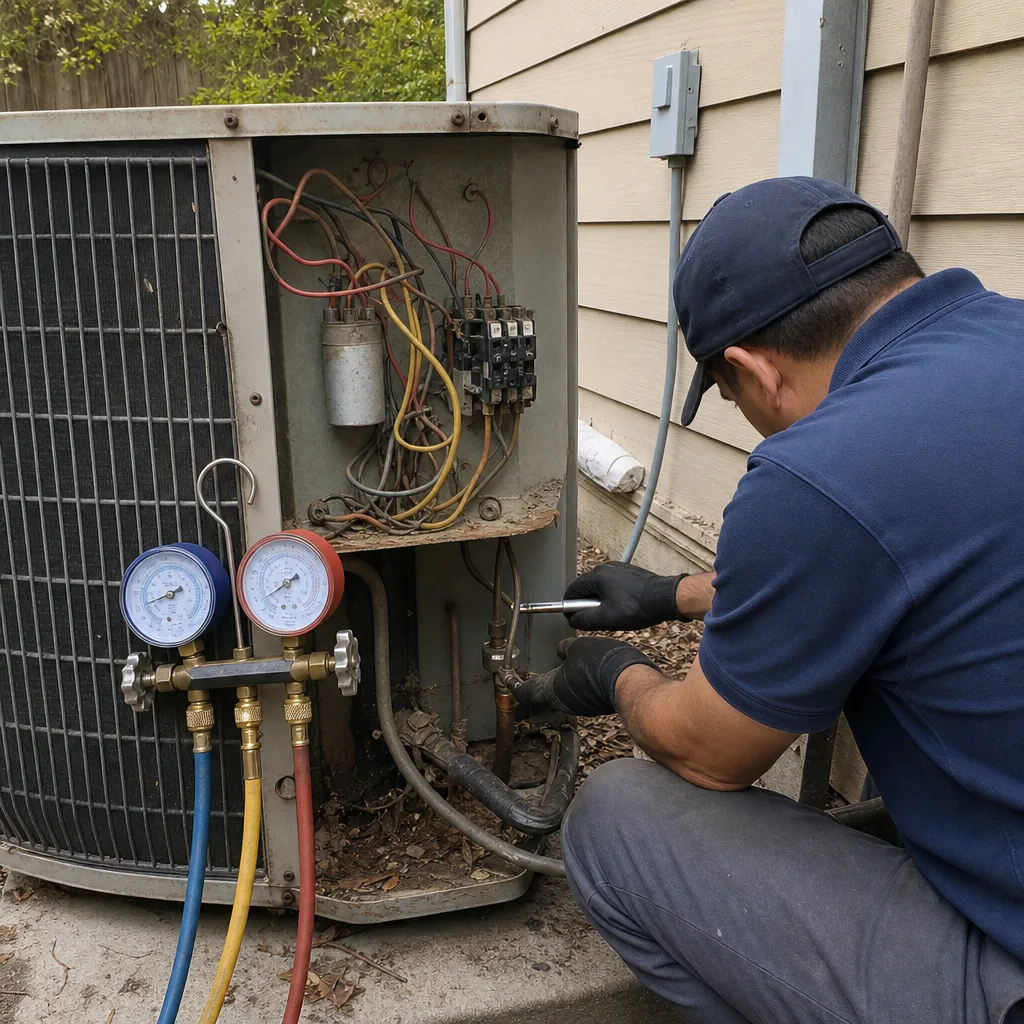 Before
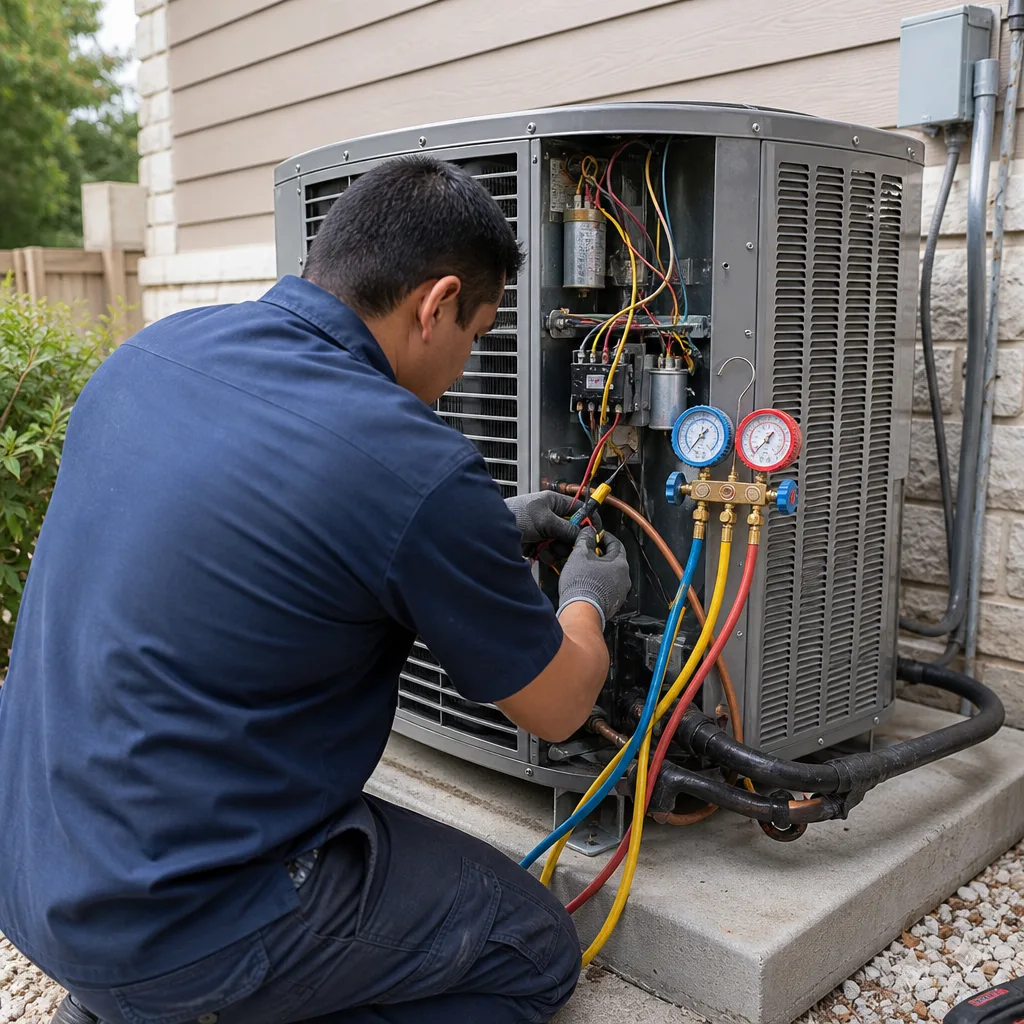 After
After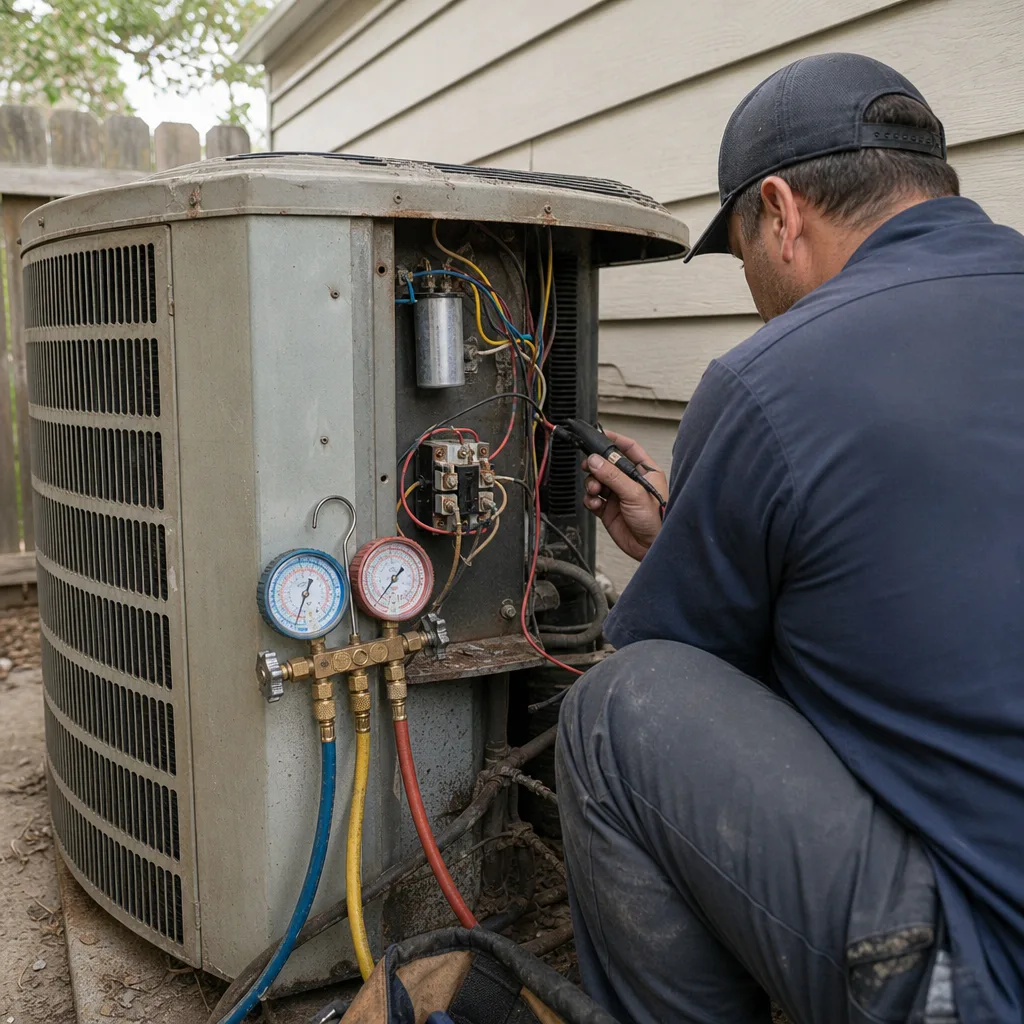 Before
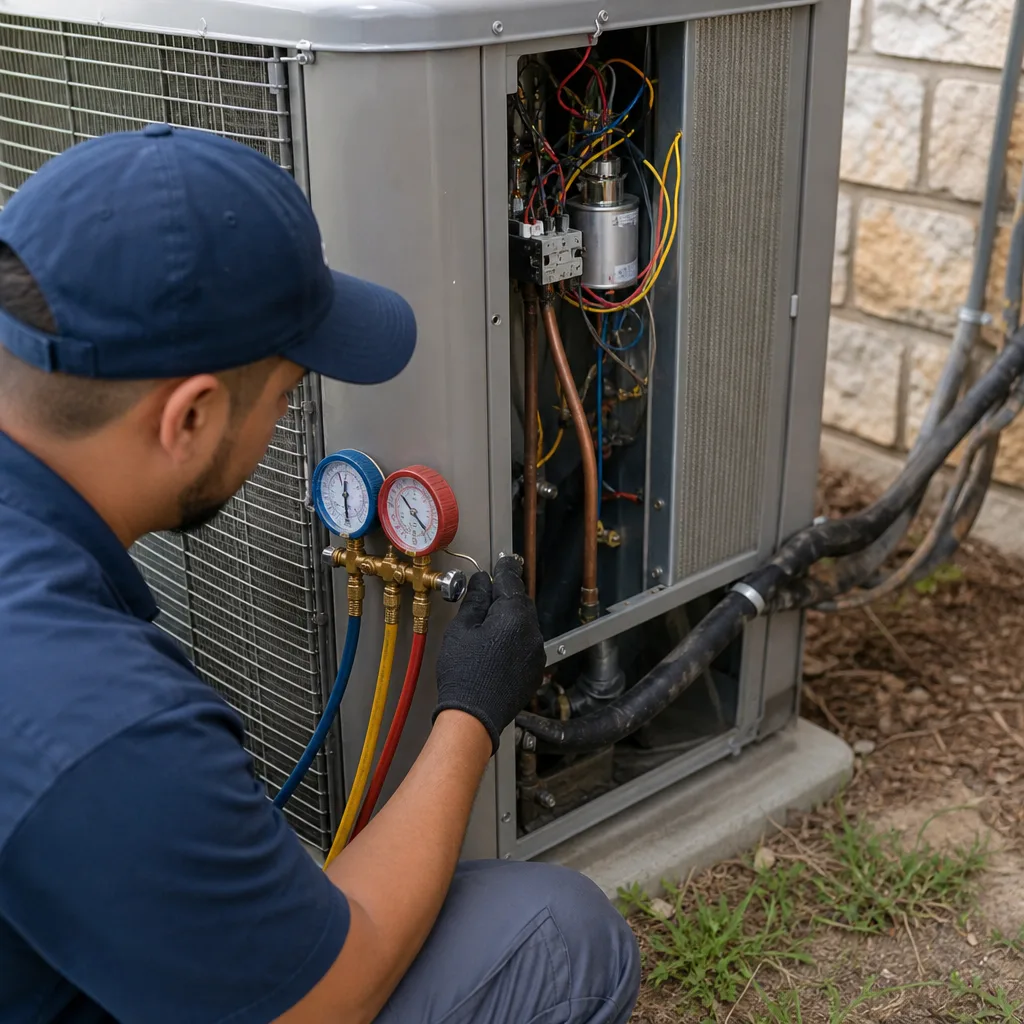 After
AfterWhen to Call a Professional
Some jobs are safe to evaluate yourself: a tripped breaker, a dirty filter, a thermostat with dead batteries. But the components that actually fail under load in San Antonio, capacitors, compressors, refrigerant lines, electrical disconnects, are not DIY territory. A capacitor holds an electrical charge even when the power is off. Refrigerant is a controlled substance that requires an EPA certification to handle. A 240-volt disconnect can kill. If your system is blowing warm air, making a grinding noise from the outdoor unit, or tripping the breaker repeatedly, do not open the panel. Call a licensed contractor. Brandt HVAC Co San Antonio home page has the full picture on our service area and standards, and we offer free estimates throughout San Antonio. Call (361) 470-8872 to get a real person on the phone, day or night.
Frequently Asked Questions
Most San Antonio HVAC repairs run between $150 and $650 in 2026, with common fixes like capacitor replacement at $150 – $340 and blower motor replacement at $450 – $950. Full system replacement runs $6,800 – $13,500 depending on tonnage, efficiency tier, and warranty terms. Call (361) 470-8872 for a written quote on your specific system.
Yes, most San Antonio HVAC companies offer same-day repair availability during peak season, and many run emergency service lines. However, same-day service during July and August often carries a premium service-call fee. If your system is limping but not dead, scheduling for the next morning can save you $75 – $150 on the diagnostic visit.
In San Antonio, where systems run 3,000+ hours per year, the repair-versus-replace math favors replacement earlier than in cooler climates. A good rule is the $5,000 rule: multiply the repair cost by the system age in years. If the result exceeds $5,000, replacement is usually the better financial decision. In our market, lean toward replacement a year or two sooner than the rule suggests.
A new AC system in San Antonio costs $6,800 – $13,500 installed in 2026, with most 3-ton systems landing between $8,500 and $11,500. After CPS Energy rebates and the federal 25C credit, a qualifying high-efficiency system can net out at $6,900 – $9,500. The final number depends on tonnage, SEER2 rating, and whether the quote includes a permit and a substantial labor warranty.
Yes, CPS Energy rebates are active in 2026 for qualifying high-efficiency AC units and heat pumps. Typical rebates range from $300 to $800 depending on equipment tier, and heat-pump conversions often qualify for the higher end. The rebate is applied at purchase when the contractor is registered in the CPS Energy program.
The variation is usually equipment tier, warranty terms, and installation quality, not markup. A $7,500 quote for a base-model single-stage unit with a 1-year labor warranty is a different job than a $11,000 quote for a variable-speed unit with a 10-year labor warranty and a permit included. The three questions to force true comparability are: Is the permit included? What does the labor warranty cover? What are the model numbers and SEER2 ratings?
The Bottom Line
San Antonio HVAC pricing in 2026 is knowable. Common repairs run $150 – $950. Full replacements run $6,800 – $13,500 before rebates, and $1,500 – $3,500 less after CPS Energy and federal 25C incentives. The spread between quotes is mostly equipment tier, warranty depth, and installation rigor. Schedule work in the off-season, ask the three comparability questions, and never accept a quote that does not name the equipment by model number. Informed homeowners pay fair prices. Uninformed homeowners pay whatever the market decides that week. Getting the information is free.
Ready for a written quote from a San Antonio contractor who tells you exactly who is coming to your door? Call (361) 470-8872 for a free estimate on repair, replacement, or maintenance. No voicemail. No phone tree. A live person answers, 24/7.
Written by Devin Marlowe, Owner at Brandt HVAC Co San Antonio, serving San Antonio since 2003.